

Live Event Production San Diego
Enterprise AV & Conference Production
A live event runs once. There's no second take on a keynote in front of 400 people. There's no re-do on a hybrid stream reaching 2,000 remote attendees. The team behind the room decides whether the event gets remembered for the message, or for the mishap.
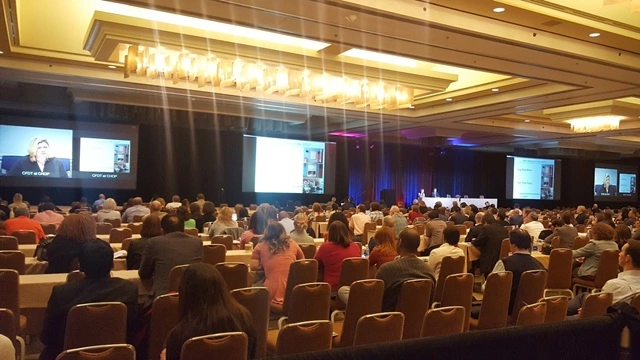
Live Event Production San Diego Companies Actually Trust With Their Biggest Events
San Diego, Los Angeles, Phoenix, Las Vegas, Irvine, Sacramento, and Anaheim companies booking a conference, sales kickoff, or product launch tend to ask the same question first: is this a rental vendor, or a production partner who owns the outcome?
The best live event production companies in San Diego do far more than supply equipment. They coordinate planning, staging, streaming, and on-site execution through one experienced team accountable for the whole event, from the first walkthrough to strike. That standard applies whether you're calling it corporate live events, conference production, or hybrid event production. San Diego companies searching for any of those terms are usually looking for the same thing.
Live Event Production Snapshot
|
Focus |
Enterprise conferences, corporate events, large-scale venue experiences |
|
Coverage |
Downtown San Diego, La Jolla, Del Mar, Coronado, Mission Valley, Carlsbad, and beyond |
|
Formats |
In-person, hybrid, and fully virtual production |
|
Standard |
One lead producer per event, redundant systems built in, not sold as an upgrade |
The Live Event Partner San Diego Businesses Actually Need
San Diego's event market spans several distinct areas, and each one behaves a little differently:
- Downtown San Diego and the Gaslamp Quarter — citywide conventions, high attendee volume, tight general-session timing
- La Jolla, Del Mar, and Coronado — executive briefings and boardroom-scale events, where a visible mistake isn't an option
- Mission Valley, Mission Bay, and UTC — mid-size conferences and multi-day meetings
- Carlsbad and Sorrento Valley — biotech, life sciences, and tech-sector meetings, where compliance and precision matter as much as production value
- Little Italy — brand activations and smaller executive gatherings
-
Most AV companies are built around one of these tiers. A rental house can staff a projector for a small meeting downtown just fine. Running a 2,000-person hybrid product launch in Mission Valley and a live general session in Carlsbad the same week is a different problem entirely, and it takes a team built around one lead producer rather than a rotating bench of subcontractors.
By the numbers: 60% of corporate event planners now rank advanced AV support as a top booking priority. (Source: Booking.com for Business, 2026 Corporate Events Statistics report) Production quality has moved from a nice-to-have to a deciding factor in who gets the contract.
Companies that rent equipment, and companies that own the event from pre-production through strike, are not the same kind of vendor. The comparison table further down shows exactly where that difference shows up.
Why Enterprise Events Fail
Five pressure points come up on nearly every large-scale event, whether or not anyone says them out loud.
- Executive embarrassment. A dead microphone during a keynote doesn't read as a glitch to the room. It reads as a company that wasn't ready. The executive on stage won't remember who was responsible, only that it happened.
- Day-of chaos. Rooms change. Speakers swap. Someone asks for a stream add the morning of the event. A production team can make that call on-site, in seconds. A rental crew usually has to phone the warehouse first.
- Vendor management stress. Three vendors for staging, lighting, and streaming means three invoices and three people to point to when something slips. One team removes that coordination tax.
- Remote attendee experience. For a hybrid event, the stream is the event for everyone not in the room. Redundant encoding and failover connectivity are the reason a dropped connection stays invisible instead of becoming a headline.
- Professional reputation. Usually the one planners care about most, even if they don't say it out loud. Your name is attached to this event internally, whether or not it's on the program.
Services Built Around Business Outcomes, Not Equipment Lists
Conference & General Session Production
A room holding 500 executives and one general session leaves no margin for a delayed start.
- Full-service staging
- Audio reinforcement
- Multi-camera IMAG production
Hybrid Event Production
When half the audience is remote, the stream has to be treated as the primary deliverable, not an add-on.
- Bonded internet failover
- Redundant encoding
- Platform-agnostic streaming
Corporate Gala & Large-Scale Venue Experiences
When the event itself is the brand moment, an anniversary, an award show, a flagship product reveal, the production has to carry that weight.
- Lighting design
- Scenic fabrication
- Stage direction
Executive Briefing & Boardroom Production
The audience might be ten people instead of a thousand. The production standard doesn't drop.
-
- EDID-compliant signal chains
- Confidence monitoring
- Low-footprint, white-glove setup
Behind the Scenes: Technology & Logistics
Most of what keeps a live event on track never gets seen by the audience.
- Signal chain — 12G-SDI transport and EDID-compliant handoffs between sources keep video clean across every switch and scaler.
- Streaming infrastructure — bonded cellular and wired failover mean a single dropped connection doesn't turn into a dead feed.
- Logistics planning — load-in and load-out get scheduled directly with venue engineering and security, especially at high-traffic downtown and convention-center properties.
- On-site staffing — a lead producer stays on-site for the full event window. Rental technicians rotate; a production team doesn't.
Common planning gap: A venue's in-house AV team can usually handle a podium mic and a single screen without issue, but wasn't built for simultaneous hybrid streaming and multi-camera production at the same time. Catching that gap during the discovery call, rather than during rehearsal the night before, is often the difference between a smooth show and a scramble.
Venue Experience Across San Diego
Production support for events at venues such as:
- San Diego Convention Center
- Manchester Grand Hyatt San Diego
- Marriott Marquis San Diego Marina
- Hilton San Diego Bayfront
- Omni San Diego Hotel
- Estancia La Jolla Hotel & Spa
- The US Grant
- Rancho Bernardo Inn
- Town & Country Resort
- Hilton La Jolla Torrey Pines
Industries Served
Live event production across San Diego's core industries, each with its own compliance, security, or messaging requirements that a generic AV vendor isn't built to anticipate:
- Biotech & life sciences — investigator meetings, product launches, CME events
- Defense & government contracting — security-cleared venues, controlled information handling
- Technology & software — product launches, developer conferences, sales kickoffs
- Tourism & hospitality — brand activations, franchise conferences
- Financial services — shareholder meetings, compliance-reviewed presentations
How We Compare Generic AV Vendor Live Event Production Partner
|
Generic AV Vendor |
Live Event Production Partner |
|
|
Accountability |
Equipment coordinator dispatched per booking |
One lead producer assigned to the event |
|
Backup Systems |
Available as an upgrade |
Standard on every deployment, not an add-on |
|
Vendor Structure |
Separate vendors for staging, lighting, streaming |
Single crew, one point of contact |
|
Technical Depth |
Standard rental inventory |
12G-SDI, bonded cellular failover, EDID-compliant signal chains |
|
Multi-City Consistency |
Local-market only; quality varies by city |
Same production standard nationwide |
|
Venue Familiarity |
General venue list |
Direct experience at named San Diego venues |
See the Accountability and Backup Systems rows answered in writing before signing. Verbal reassurance and a contractual commitment aren't the same thing.
The Production Process, Step by Step
- Discovery & Risk Assessment — Venue walk-through and technical requirements mapped out before anything gets ordered.
- Production Planning — Full run-of-show built with a named lead assigned to the event.
- Pre-Event Technical Rehearsal — Complete system and backup test before doors open. Not a day-of surprise.
- Live Execution On-site direction managing the room in real time, with backup systems already active.
- Post-Event Debrief & Assets Recordings delivered, lessons documented, so the next event starts a step ahead.
From Discovery to Show Day
Companies evaluating a live event production partner in San Diego usually go through the same five steps before signing anything:
- Discovery call — a short conversation about goals, dates, and format, whether that's in-person, hybrid, or fully virtual.
- Technical consultation — a closer look at the AV, staging, and streaming requirements specific to the event.
- Venue review — walk-through or remote assessment of what the venue can actually support.
- Proposal — an itemized production plan with named accountability and backup coverage spelled out, not implied.
- Production planning — run-of-show development, rehearsal scheduling, and staffing assignment before event day arrives.
The Real Cost of Getting It Wrong
- A failed keynote microphone doesn't just interrupt a talk. It undermines an executive's credibility in front of the room that mattered most.
- A streaming interruption during a hybrid event doesn't just lose a feed. It loses the remote audience for good; there's rarely a way to win that attention back once the screen goes dark.
- Poor audio in a general session doesn't just sound bad. It triggers measurable engagement drop-off long before the session ends.
- An uncoordinated handoff between staging, lighting, and streaming vendors creates a specific kind of gap: nobody is responsible for catching the problem before the audience sees it.
Nearly every scenario above traces back to the same root cause: no single person accountable for the room. That's the gap the comparison table above exists to close.
Frequently Asked Questions
Ready to Deliver a Live Event Without the Guesswork?
Talk with our production team today to discuss your event goals, venue requirements, and timeline, and discover how enterprise-grade live event production in San Diego can help you deliver a seamless, memorable experience.