

SKO AV Checklist: The Guide for Hybrid & In-Person Sales Kickoffs
03/01/2026
10 Corporate Event Trends in 2026 Every Enterprise Planner Must Know
05/01/2026
In high-stakes enterprise environments, the challenge isn’t stage design—it’s controlling multiple global brand identities in real time without compromising speed, clarity, or broadcast quality.
This project was defined by three core requirements:
- Objective: Integrate multiple global brands into a cohesive, broadcast-grade stage.
- Challenge: Brand governance and sightline optimization for 1,000+ attendees.
- Solution: Modular scenic panels, 5600K calibrated lighting, and DMX-LED washes.
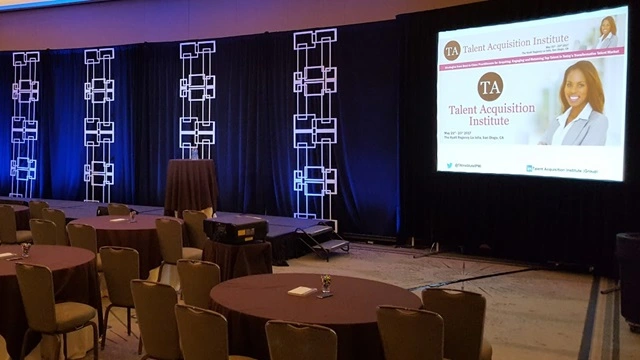
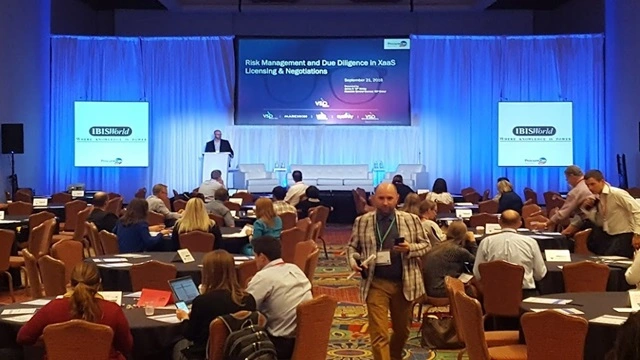
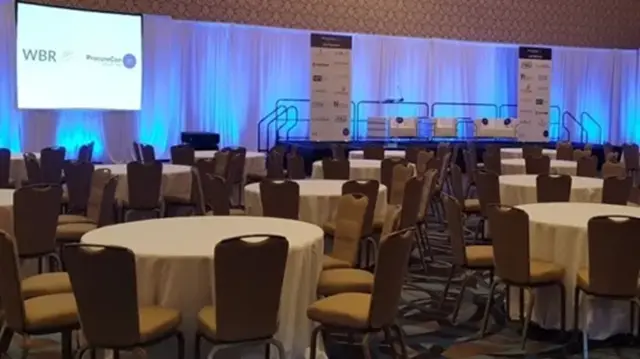
Set Design from EmAV Events
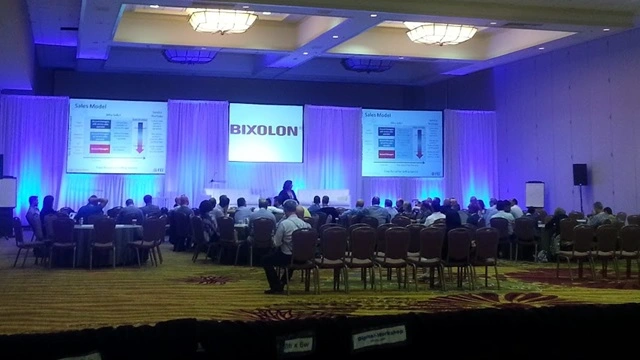
1. The Challenge: Sponsor Conflict Risk
The client (Tag, Coupa, Zycus) required equal visual dominance, creating potential conflicts in brand visibility and contractual ROI delivery.The system was required to support full visual transitions within a 120-second window between keynote sessions.
Audience Engagement Drop-Off
Deep-hall configuration risked losing up to 30% audience engagement beyond row 20 due to poor visual clarity.
Content Quality Degradation
Standard ballroom lighting risked overexposing brand colors, compromising recorded content and post-event marketing assets.
2. The Solution: Adaptive Scenic & Chroma-Correct Lighting
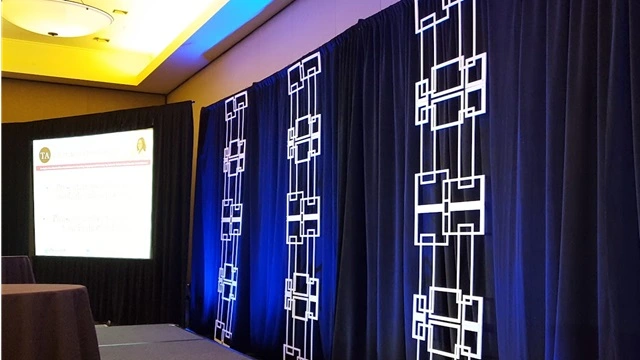
We moved away from traditional pipe and drape in favor of an Integrated Scenic System that prioritized depth and digital parity.
Geometric Depth Modules
To eliminate sponsor conflict without physical resets, we implemented geometric depth modules with integrated DMX-controlled LED systems—enabling instantaneous full-environment color transitions aligned with sponsor branding.
Visual Parity Engineering (VPE)
To address visibility limitations across the ballroom, we implemented Visual Parity Engineering (VPE):
Primary Anchor: A central high-brightness LED matrix for data-heavy executive slides.
Peripheral Anchors: Flanking 4K monitors dedicated strictly to sponsor branding, ensuring logos were never obscured by a speaker's head.
Studio-Grade Illumination
Lighting was engineered using spatial design principles to separate visual zones:
- Executive Zone: Calibrated 5600K key lighting for accurate skin tones and clarity.
- Scenic Zone: High-saturation DMX-controlled washes for brand expression.
This separation created a layered, three-dimensional visual effect optimized for both in-room experience and 4K/8K broadcast capture.
3. Strategic Impact: Data-Backed Results
This engineering-led approach delivered measurable gains in both operational efficiency and audience sentiment:
Zero-Lag Branding
Achieved 100% brand transitions in <10 seconds via software-defined lighting presets.
Optimum Visual Range
Post-event surveys confirmed 100% visibility for attendees in the furthest Networking Zone.
High-Fidelity Assets
Delivered 4K master files with Delta E < 2.0 color accuracy, ready for immediate global distribution.
Operational Savings
The modular build reduced on-site labor hours for stage resets by 40%.
Key Takeaway
In enterprise event environments, lighting and scenic systems are no longer just design elements—they function as programmable infrastructure.
By shifting from static staging to adaptive systems, it becomes possible to:
- Eliminate transition delays
- Maintain brand integrity at scale
- Reduce operational complexity
- Maximize sponsor ROI
The Expert Insight (The Eleven Eleven Way)
This project proved that technical precision in DMX engineering isn't just about aesthetics.It’s a logistical tool that reduces labor costs and maximizes sponsor ROI.