
Case Study Architectural Brand Immersion & High-Velocity Transitions
04/24/2026
SKO Event Planning Guide: 2026 Framework for Sales Leaders
05/01/2026
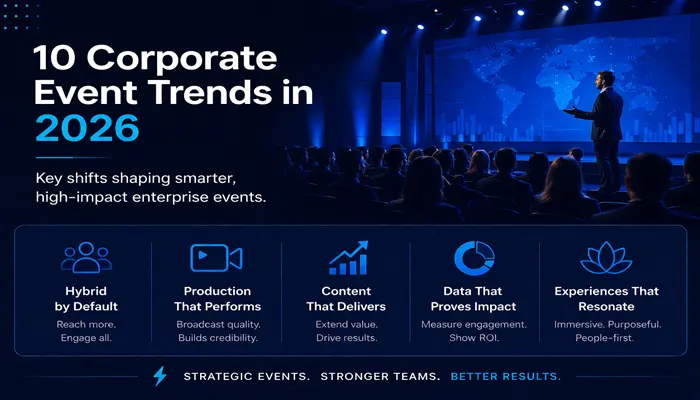
Planning a major corporate event this year? The rules have changed. Gone are the days when a rented ballroom, a projector, and a catered lunch counted as a corporate event.
In 2026, enterprise leaders — from CROs to VP Sales — are demanding events that move the needle. Events that energize revenue teams. Events that produce measurable outcomes.
And the production standards required to deliver that? They've never been higher.
We've spent the last decade producing enterprise events across 18+ U.S. states. This is what we're seeing on the ground — and what it means for your next event. focus on definition, strategic value, structure, and business impact.
What Are the Biggest Corporate Event Trends in 2026?
The biggest corporate event trends in 2026 center on one theme: strategic intent. Events are being redesigned as revenue tools, not just gatherings. The dominant shifts include hybrid production as a baseline standard, AI-powered engagement and analytics, immersive stage design, shorter high-impact keynotes, and a hard expectation of measurable post-event ROI.
That's the short answer. But if you're responsible for executing any of this — the details matter enormously.
Let's break down each trend and what it actually demands from your production team.
Trend 1: Events Are Now Revenue Investments — Not Just Line Items
Here's a shift that's been building for years but has fully arrived in 2026: enterprise leadership no longer views events as costs. They view them as investments.
According to the American Express GBT Global Meetings & Events Forecast, 85% of event professionals are optimistic about 2026 — the highest confidence level in five years. That optimism isn't just sentiment. It reflects a fundamental repositioning of what events are for.
Your CFO isn't asking how much did this cost anymore.
They're asking: What did we get for it?
What this means for your planning:
- Every event decision venue, AV, lighting, staging needs to tie back to a business outcome
- Budget conversations shift from justifying costs to presenting expected returns
- Your production partner needs to understand revenue psychology, not just technical specs
At 11:11 AV, every engagement starts with a strategy alignment session. We don't touch a lighting plot or a sound map until we understand what your event is supposed to accomplish commercially.
That's not a production vendor mindset. That's a production partner mindset.
Trend 2: Hybrid Is No Longer Optional — It's the Standard
If you're still treating a virtual stream as a nice add-on, you're already behind.
Hybrid event production has moved from a contingency option to a baseline expectation. In 2026, enterprise organizations routinely have remote employees, distributed leadership teams, and global stakeholders who cannot or will not travel for every event.
The numbers confirm it:
- 83% of organizers report higher overall attendance with hybrid formats (AMW Group, 2026)
- 63% of event planners expect hybrid to be the most common format by 2027 (Statista)
- Adding a virtual component increases total event reach by 2.5x on average
But here's what most people get wrong about hybrids: it's not about the stream. It's about the experience of parity.
A poorly produced hybrid event doesn't just fail virtual attendees. It visibly fails — on screen, in real time in front of your entire remote audience.
What true hybrid production requires:
- Multi-camera broadcast setup with professional directors and operators
- Redundant internet (bonded cellular + dedicated fiber — not the hotel WiFi)
- A lighting design built for both the in-room audience and the camera lens
- A dedicated remote audience engagement strategy, not just a Zoom link
- Real-time technical monitoring throughout the event
Our hybrid event production services are engineered specifically for this — because consumer-grade hybrid setups don't belong at enterprise events.
Trend 3: Production Quality = Executive Credibility
This one is worth sitting with for a moment.
When your CEO walks onto a poorly lit stage with muddy audio and a pixelated LED backdrop, what does that communicate to 500 employees — or 2,000 remote viewers?
It communicates that leadership didn't think this was important enough to get right.
In 2026, the standard for production quality at enterprise events has converged with broadcast television standards. Your executive isn't just speaking to the room anymore. They're speaking to a camera. That camera is broadcasting to employees in twelve time zones.
The production details that now define executive presence:
| Element | Basic Standard (2019) | Enterprise Standard (2026) |
| Stage Lighting | Even wash, no shadows | Multi-layer design, camera-optimized, brand-color LEDs |
| Audio | Lapel mic, basic PA | Redundant wireless, zoned speakers, real-time monitoring |
| Visuals | PowerPoint on screen | Broadcast-quality video playback, seamless transitions |
| Camera | Single static wide shot | Multi-camera with director, clean close-up capability |
| Streaming | Optional Zoom link | Dedicated encoder, CDN delivery, 99% uptime SLA |
The gap between basic and enterprise standard is no longer acceptable to close with excuses.
At 11:11 AV, we build every stage to serve both the room and the camera — because in 2026, those are equally important audiences.
Trend 4: AI Is Reshaping How Events Are Planned and Measured
AI isn't replacing event production teams in 2026. But it is changing what production teams are expected to deliver.
According to Bizzabo's 2026 State of Events Benchmark Report, 95% of event organizations expect their use of AI to increase this year. And 50% of industry professionals are already using it in some part of the planning or execution process (Amex GBT).
Here's how AI is showing up in real enterprise events right now:
Pre-event:
- Automated attendee communications and personalized agenda recommendations
- AI-assisted run-of-show scheduling to eliminate timing conflicts
- Predictive analytics for AV and venue cost forecasting
During the event:
- Real-time audience sentiment analysis from facial recognition and engagement data
- AI-moderated Q&A that filters and surfaces the best questions
- Live polling tools that adjust session flow based on audience response
Post-event:
- Automated highlight clip generation from raw event footage
- Searchable content libraries built from session recordings
- Engagement heatmaps that show what resonated and what didn't
Research from 2026 indicates that on-demand content built from event footage can extend lead generation by two to three months and deliver a 60% uplift in leads compared to events without a content strategy (2stream.live).
That's where your event recording services and AI-driven post-production become a serious revenue multiplier — not just a nice to have.
Trend 5: Short, High-Impact Keynotes Are Replacing Marathon Sessions
Nobody wants to sit through a 90-minute keynote in 2026. Including your executives.
The shift toward TED-style, high-density presentations of 20 minutes or less has accelerated sharply. Enterprise audiences — especially sales teams at SKO events — want information delivered with intensity, not duration.
This has massive production implications.
When your keynote window compresses from 60 minutes to 20, every single minute of that session needs to land. The lighting cue when your CEO enters. The sound design during the product reveal. The transition timing between speakers.
There is no fat to hide behind when the clock is tight.
This is why production rehearsal matters more than ever. At 11:11 AV, our pre-event engineering phase includes full technical rehearsals against the actual run-of-show timeline — so your 20-minute keynote runs exactly 20 minutes, flawlessly.
Short formats also require a different staging philosophy. Instead of a single stage focal point, enterprise planners in 2026 are building multiple touchpoints within a single room — runway-style stages, satellite screens, breakout activation zones — all of which must be designed, lit, and wired cohesively.
Our event set design services specialize in exactly this kind of multi-format room architecture.
Trend 6: Immersive Stage Design Is Driving Audience Engagement
This is the trend that separates a forgettable event from one your team talks about for six months.
Immersive, sensory-driven stage environments have become the new standard for enterprise events. This isn't about theatrical excess — it's about using design to reinforce your message.
In 2026, brands are using stage design to:
- Communicate company culture before a single speaker takes the stage
- Reinforce product messaging through environmental branding
- Create emotional peaks that your sales team carries back into the field
The key elements driving immersive production in 2026:
LED Video Walls — No more projector screens. High-resolution LED walls deliver brand visuals that remain vivid under any lighting condition and scale flawlessly for both intimate leadership summits and large general sessions.
Layered Lighting Design — Moving lights, color temperature shifts, and programmable lighting cues can transform a room's energy in seconds. That moment when the lights drop and the product reveal video plays? That's engineered, not accidental.
Branded Environmental Design — Signage, set pieces, and architectural elements that turn an empty ballroom into a brand experience. When attendees walk in and immediately feel the weight of the occasion, your message starts working before the first speaker is introduced.
Sound Design as Storytelling — Audio isn't just about volume and clarity (though both matter). It's about how sound builds anticipation, punctuates a reveal, and creates the silence before a big moment.
Our enterprise event lighting solutions and event video services are designed to work together — because immersive production isn't about individual elements, it's about a coordinated system.
Trend 7: Event Recording Has Become a Revenue Multiplier
Here's a trend that most enterprise planners are still leaving money on the table with.
Your event isn't a moment anymore. It's a content library.
The most forward-thinking revenue leaders in 2026 treat their event recordings as assets, not archives. A well-produced SKO keynote becomes onboarding content for new sales hires. A product launch session becomes a shareable asset for customer success. A leadership summit session becomes training material for managers who weren't in the room.
The math is compelling:
- 82% of event organizers now create video-on-demand content from live events (Bizzabo, 2026)
- On-demand content achieves higher consumption rates than live sessions
- Events with a post-production content strategy generate 60% more leads over the following 90 days
But the quality of that content depends entirely on how it was captured.
A single wide-angle static camera produces archive footage. A multi-camera professional setup with clean audio, proper lighting, and a directed record feed produces broadcast-quality content.
The difference in production investment is meaningful. The difference in content value is enormous.
Our event recording services are built around the broadcast standard — because your content is only as good as the capture.
Trend 8: SKO Events Are Getting a Strategic Upgrade
Of all the corporate event trends in 2026, this is the one closest to our core at 11:11 AV.
Sales Kickoff events are being treated with a level of strategic seriousness they've never had before.
In previous years, SKOs were often planned as large company gatherings — inspirational, celebratory, and loosely structured. In 2026, the CROs and VP Sales we work with are approaching SKOs the way a broadcast network approaches a live show.
Every minute is scripted. Every transition is designed. Every production element is evaluated against one question: does this increase revenue performance?
What's driving this shift:
- Pipeline accountability — Revenue teams are under more scrutiny than ever. The SKO has to directly accelerate Q1 and Q2 momentum.
- Hybrid complexity — SKOs with 30% remote attendees need a production strategy that keeps virtual sales reps as engaged as the people in the front row.
- Executive messaging precision — When the CRO's keynote sets the tone for an entire fiscal year, the lighting, sound, and staging around that message has to amplify it — not undercut it.
We've produced SKO events that have increased sales team engagement by up to 90% and delivered 100% message clarity scores from post-event measurement.
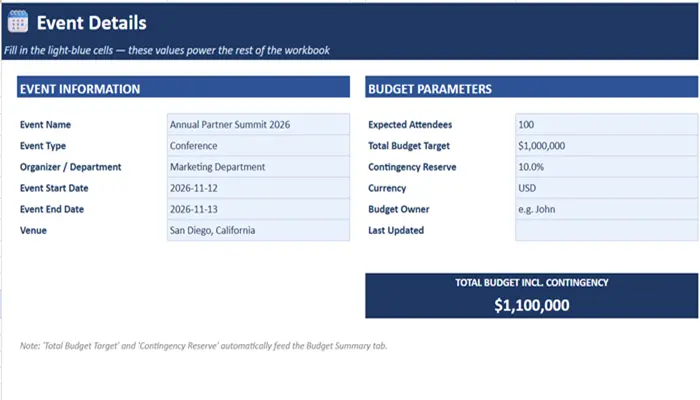
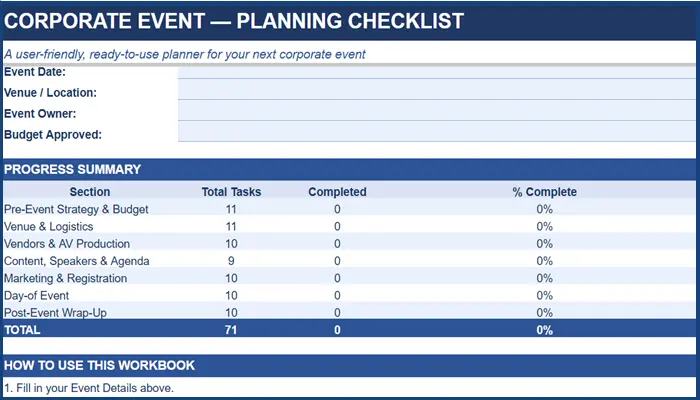
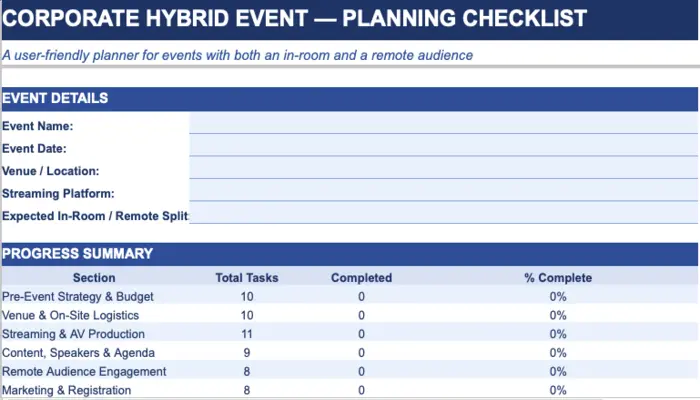
If you're planning your 2026 SKO, read our detailed SKO Event Planning Guide — it covers every production decision from venue selection to post-event content strategy.
Trend 9: Wellness Is Being Built Into Event Architecture
This one surprises some of our clients — but it's very real.
Wellness has moved from a perk to a production consideration. Enterprise event planners in 2026 are designing physical and programming elements that support attendee energy levels, cognitive performance, and engagement capacity.
This isn't yoga mats in the hallway.
It's:
- Pacing design — Session lengths and break structures engineered around human attention cycles, not just agenda convenience
- Lighting for energy — Tunable white lighting that shifts color temperature to support alertness during working sessions and recovery during breaks
- Sound environment design — Acoustic management that prevents listener fatigue in multi-hour sessions
- Physical space flow — Room layouts that encourage movement between sessions rather than passive sitting
From a production standpoint, wellness design requires your AV and lighting systems to do more than look good. They need to function biologically.
Our technical team factors lighting ergonomics and acoustic management into every stage and ballroom design — because a fatigued audience isn't an engaged audience.
Trend 10: Data-Driven ROI Reporting Is Now Expected
The final trend connects everything above.
Enterprise event planners in 2026 are expected to deliver ROI reports, not just recap decks.
The Amex GBT Forecast confirms that 76% of organizations now use formal approval processes for events — up from just 47% previously. That means more stakeholders, more scrutiny, and a higher bar for proving event value.
What enterprise ROI measurement looks like in 2026:
- Engagement metrics — Audience attention data, interactive participation rates, Q&A volume
- Content performance — On-demand view rates, session completion percentages, clip shares
- Pipeline impact — Revenue opportunities created or accelerated in the 90 days post-event
- Alignment scores — Pre/post event surveys measuring message retention and team alignment
- Production uptime — Technical performance data: audio clarity, streaming stability, zero-failure confirmation
At 11:11 AV, our post-event optimization phase delivers production performance reporting alongside standard event recap materials — because your stakeholders deserve to stay informed.
How These Trends Affect Your AV and Production Strategy
Reading these trends is one thing. Executing against them is another.
Here's a clear summary of what each trend demands from your production partner in 2026:
| Corporate Event Trend | Production Requirement |
| Events as revenue investments | Strategy-first production planning aligned to business KPIs |
| Hybrid as standard | Broadcast-grade streaming, redundant internet, multi-camera |
| Executive credibility through production | Camera-optimized lighting, professional audio, clean visual design |
| AI-driven engagement | Compatible AV infrastructure for interactive engagement tools |
| Short, high-impact keynotes | Full technical rehearsal, tight run-of-show execution |
| Immersive stage design | LED walls, programmable lighting, branded environment design |
| Event recording as content | Multi-camera capture, broadcast audio, post-production delivery |
| SKO strategic production | Revenue psychology understanding, engagement-optimized staging |
| Wellness in event design | Tunable lighting, acoustic management, intentional pacing |
| Data-driven ROI reporting | Technical performance reporting, engagement data capture |
The common thread across every single one of these? Production quality is no longer a support function. It's a strategic driver.
That's the case we've been making since we started 11:11 AV in 2015. And in 2026, the market has fully caught up.
Frequently Asked Questions
What are the most important corporate event trends for enterprise planners in 2026?
The most critical trends for enterprise planners in 2026 are the shift to hybrid as a standard format, the elevation of production quality as an executive credibility signal, AI integration for engagement and analytics, and a firm expectation of measurable ROI from every event. Organizations that treat these as optional are already falling behind their competitors.
How is hybrid event production different from simply live streaming an event?
Live streaming sends a single feed to remote viewers. Professional hybrid event production engineers a full parallel experience — with multi-camera direction, dedicated remote audience engagement tools, broadcast-quality encoding, and redundant internet systems. The goal is experience parity: your virtual attendees should feel as present and engaged as the people in the room.
Why does AV production quality matter for executive credibility?
In 2026, enterprise events are broadcast to remote employees, global stakeholders, and virtual participants simultaneously. Poor lighting, muddy audio, or technical failures are not just inconveniences — they visibly undercut the authority and professionalism of your leadership team in front of your entire audience. Production quality is a direct reflection of organizational standards.
How can companies measure ROI from corporate events?
Enterprise ROI measurement in 2026 goes far beyond headcount and satisfaction surveys. Leading organizations track audience engagement rates, content consumption post-event, pipeline opportunities created within 90 days, message alignment scores from pre/post surveys, and technical performance data. Your AV and production partner should support data capture that feeds directly into these metrics.
What is a Sales Kickoff (SKO) event and how is production different?
A Sales Kickoff is an annual event designed to align, motivate, and accelerate a revenue team ahead of a new fiscal year. SKO production differs from standard corporate event production because it requires deep understanding of revenue psychology, motivational design, executive message amplification, and engagement engineering for large sales audiences — often with a significant hybrid component.
How far in advance should enterprise organizations book event production?
For large-scale enterprise events — particularly SKOs, national conferences, and hybrid summits — most organizations in 2026 are booking production partners 4–6 months in advance. High-demand markets like Las Vegas, New York, Chicago, and San Diego fill quickly. Early engagement also allows for the strategy alignment and technical design work that separates seamless execution from last-minute scrambles.