12 Trade Show Booth Design Ideas That Pull Visitors In (2026)
11/19/2026
A trade show marketing strategy is a plan for what you do before, during and after an event to bring the right people to your booth, capture their details and turn those conversations into sales meetings.
It covers promotion, the booth experience and follow-up, not just the booth itself.
A booth space and a good banner do not make a trade show pay off. The companies that leave with a full pipeline usually started promoting weeks earlier, built a booth that made conversations easy, and followed up while the prospect still remembered their name.
This guide walks through each stage in order, with a timeline, a KPI table and a list of the mistakes we see most often. It also covers the part many marketing guides skip: how screens, lighting and sound decide whether a visitor stops or walks past. Eleven Eleven Audio Visual team wrote it for marketing teams and exhibitors who want a plan they can actually run. A KPI scorecard is available to download near the end.
The Plan at a Glance
|
When |
Focus |
What to do |
|---|---|---|
|
12 to 8 weeks out |
Goals and audience |
Set targets, pick the audience, book the booth and brief the design team |
|
8 to 4 weeks out |
Promotion |
Launch emails, LinkedIn posts and a landing page, and start booking meetings |
|
Final 2 weeks |
Readiness |
Finalize content, test screens, brief staff, confirm lead-capture tools |
|
During the show |
Engagement |
Run demos, post live updates, qualify and capture every lead |
|
1 to 2 weeks after |
Follow-up |
Segment leads, send personal emails and book sales calls |
|
30 to 90 days after |
Measurement |
Track pipeline and revenue against your original goals |
Use the timing as a rough guide. A large show with custom construction needs more lead time than a regional one.
1. Define Your Trade Show Marketing Goals
Start with one honest question: what would make this show a success? If the answer is vague, the booth, the promotion and the follow-up will all be vague too.
Common goals include:
- Brand awareness: getting your name in front of a defined audience.
- Qualified leads: collecting contacts who match your ideal customer.
- Product launches and demos: showing something new to people who can buy it.
- Customer relationships: meeting existing clients face to face.
- Sales and partnerships: booking meetings with named accounts.
Pick one or two primary goals, not five. Then attach a number to each before the event, such as meetings booked or qualified leads captured. Numbers set in advance keep the post-show report honest.
Tip: Write the goal as a sentence your sales team would agree with, for example: we want 30 booked meetings with operations managers at mid-size manufacturers.
2. Identify Your Target Audience
A show can have thousands of attendees and only a few hundred of them are your buyers. Narrowing the audience early shapes everything that follows.
- Read the attendee data. Most organizers publish audience profiles, job titles and company types. Use them.
- Name the decision-makers. Note who signs off, who influences the decision and who will use your product.
- Check the exhibitor list. Competitors, partners and potential customers often exhibit, and each group needs a different approach.
- Match the message to a real problem. Booth copy should speak to something your audience is trying to fix, not describe your company's history.
Let's Make Your Next Trade Show a Success
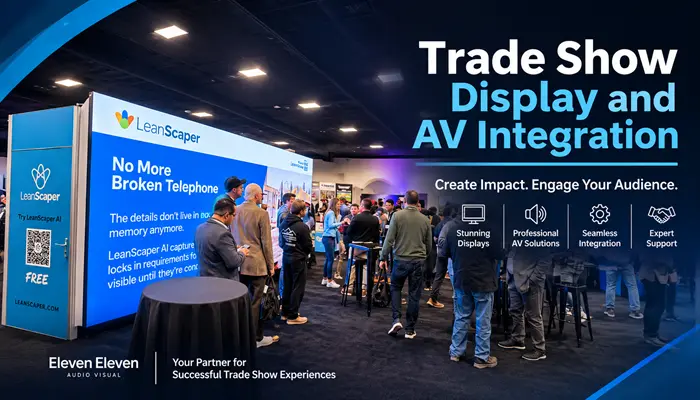
From LED video walls and booth displays to lighting, sound and onsite technical production, Eleven Eleven Audio Visual brings every element together. Tell us about your upcoming trade show and let's plan an experience that gets your brand noticed.
3. Build a Pre-Event Promotion Plan
Pre-show promotion is where most of the booth traffic is won. Visitors arrive with a schedule, and you want to be on it.
- Email invitations to your existing contacts and target accounts, with a clear reason to stop by.
- LinkedIn posts announcing your booth number, a demo time or a speaker, from both the company page and your team's own profiles.
- A simple landing page that lists the show, booth number, what you will show and a way to book a time.
- Direct outreach to named prospects, with a calendar link for a short meeting.
- A countdown of short posts, so your name appears more than once before the show.
Keep the message consistent across channels. If your email promises a live demo of a new product, the landing page, the LinkedIn post and the booth screen should all say the same thing.
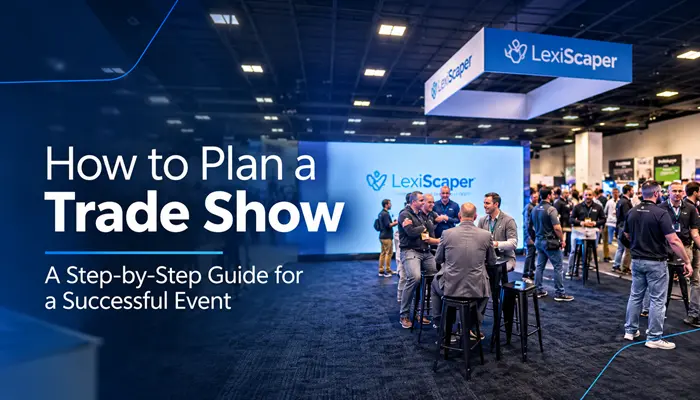
For the logistics side of getting ready, such as deadlines, shipping and staffing, our trade show planning guide lays out the timeline step by step.
4. Create an Attention-Grabbing Trade Show Booth
A booth has about three seconds to answer one question in a visitor's head: is this for me? Clear branding, a short message and an open layout answer it quickly.
What to get right:
- One clear message. Say what you do and who it is for in a line short enough to read while walking.
- An open layout. Leave an obvious way in. Tables across the front of a booth act like a closed door.
- Zones with a purpose. Separate a demo area, a quiet meeting space and a spot for quick scans and handouts.
- Layout that fits the type. Island booths can be seen from all sides, so they suit large launches. Inline booths need a stronger front and more careful use of height.
- Smart screen placement. Put the main display where it is visible from the aisle, and keep smaller screens for close-up demos.
If you are still choosing a concept, our collection of trade show booth design ideas shows how different structures, lighting and layouts suit different goals
5. Use LED Displays and AV to Improve Booth Engagement
This is where booths quietly win or lose. A good design brings people close, and AV decides whether they stay. Think of it as three jobs: get noticed, start a conversation, and keep the lead.
|
Job |
AV tool |
How it helps |
|---|---|---|
|
Get noticed |
LED wall, hanging sign, lighting |
Draws the eye from the aisle and signals where the booth begins |
|
Start a conversation |
Short demo video, product loop |
Gives visitors a reason to stop and gives your staff an opening line |
|
Explain and prove |
Touchscreen, presentation display |
Lets visitors explore at their own pace |
|
Keep the lead |
Tablet or QR on screen |
Moves interested visitors straight to a form or a meeting slot |
What works in practice:
- Show motion, not paragraphs. Screens get a glance, not a read. A 20 to 30 second loop with a clear call to action beats a slide of bullet points.
- Light for people as well as screens. Booths that light only the structure leave faces and products in the dark. Our overview of event lighting solutions covers how to balance the two.
- Test the content, not just the equipment. A wall running at the wrong resolution can make good footage look careless.
- Plan the system together. Screen size, pixel pitch, power, sound and playback all affect each other, and our guide to trade show display and AV integration explains how to choose and connect them.
Tip: Every screen should end with an action: scan, book, or ask us. A beautiful loop with no next step is a missed lead.
6. Develop Engaging Trade Show Content
The content on your screens and in your demos is part of your marketing, so treat it like a campaign asset.
- Short product videos that explain one idea in under a minute.
- Customer stories with a real name, a problem and a result, where permission allows.
- A branded presentation for scheduled talks or small group demos.
- Launch content built to be seen from a distance, with large type and few words.
- Interactive demos where visitors can try something, not just watch.
- Clear calls to action on every display.
Have your content team build to the real dimensions of your screens early. Content made for a standard TV shape often needs rework on a custom LED wall. If you need video produced from scratch, our team offers professional event video production that covers both the content and the playback
7. Promote Your Booth During the Event
Promotion does not stop when the doors open. Visitors are checking their phones and schedules all day, and live updates catch them while they are deciding where to go next.
- Post live updates with your booth number, a demo time or a short clip of something happening now.
- Cover the event on LinkedIn, tagging the show and relevant speakers, so people searching the event hashtag find you.
- Record short clips and quick interviews with staff, customers or partners. Plan who films and who posts, because it rarely happens by accident.
- Schedule your demos and talks at set times and announce them, so visitors can build them into their day.
- Invite people in, not just onto the mailing list. A friendly question at the edge of the booth does more than a banner.
If some of your audience cannot travel, a live stream of a key session can extend its reach. Our hybrid event production page explains how in-person and remote audiences can share one program.
8. Generate and Capture Qualified Leads
A stack of business cards is not a pipeline. What matters is how many of those contacts are real buyers, and whether you recorded why they were interested.
- Make capture effortless. A QR code on a screen or the counter that opens a short form is faster than a paper sign-up sheet. Badge scanners provided by the organizer are another option.
- Ask two or three qualifying questions. For example: what are you trying to solve, when are you looking to decide, who else is involved?
- Offer something in return. A demo slot, a guide or a sample gives visitors a reason to share their details.
- Book the next step on the spot. A calendar link on a tablet turns interest into a meeting before the visitor walks away.
- Push data to your CRM quickly. Leads that sit in a spreadsheet for two weeks go cold.
- Respect consent. Check the data rules for the regions your attendees come from before you collect and store contact details.
Tip: Rate each lead right after the conversation with a simple code, such as hot, warm or cold. You will not remember the difference a week later.
9. Follow Up After the Trade Show
The show only counts if the conversations continue. Treat the first week after the event as part of the show.
- Segment your leads by interest and how ready they are to buy.
- Send personal emails that mention what you talked about, not a generic thank-you.
- Share what they asked for, whether that was a spec sheet, a price range or a case study.
- Book the sales meetings while the event is still fresh.
- Connect on LinkedIn with a short note referencing the show.
- Track what happens next so you can tell which leads turned into opportunities.
Hot leads deserve a call within a few days. Warm leads can go into a short nurture sequence. Cold leads still belong on your list, but they should not take sales time.
10. Measure Trade Show Marketing Performance
If you never measure the show, you will repeat the same results. Pick a small set of indicators before the event and track them in the same place every time.
|
KPI |
What it measures |
|---|---|
|
Booth traffic |
The number of visitors who stopped |
|
Qualified leads |
Contacts who match your target customer |
|
Meetings booked |
Scheduled business conversations |
|
Engagement rate |
How many visitors interacted with a demo, screen or presentation |
|
Cost per lead |
Total event spend divided by qualified leads |
|
Lead conversion rate |
The share of leads that became customers |
|
Opportunities created |
Leads that entered your sales pipeline |
|
Pipeline value |
The expected value of those opportunities |
|
Event ROI |
The financial return compared to total event investment |
Activity counts, such as how many people walked by, are easy to gather but only tell part of the story. The numbers closest to revenue, meetings, opportunities and pipeline, tell you whether the show earned its budget. Give them the most weight.
to log your targets and results for every show in one workbook
11. Common Trade Show Marketing Mistakes
- Starting promotion too late. Visitors plan their schedules before they arrive.
- Aiming at the wrong audience. A huge crowd of irrelevant visitors is not a win.
- Unclear booth messaging. If a visitor cannot tell what you do in a few seconds, they will keep walking.
- Neglecting AV and presentation quality. Washed-out screens, stretched video and muddy sound make a good company look careless.
- Collecting leads with no follow-up plan. Contacts without a next step are just a list.
- Not measuring. Without data you cannot defend the budget or improve the next show.
12. Integrate Booth Design, AV and Marketing
The strongest results come when design, technology and marketing are planned together rather than handed from one team to the next. The booth structure decides where people walk. The screens and lighting decide what they notice. The sound decides how long they stay. The marketing plan decides who showed up in the first place. When one of these is planned in isolation, the others have to work around it.
This is the reasoning behind working with a single team that can handle fabrication, LED displays, video, lighting, sound and onsite support. At Eleven Eleven Audio Visual, that is how we approach exhibits, and you can see the full range under our integrated trade show production services. Whether you work with us or not, the principle holds: ask each vendor how their piece connects to the others before you commit.
Frequently Asked Questions About Trade Show Marketing Strategy
Make Your Next Trade Show Work Harder
A strong plan is wasted if the booth, screens and sound let it down on the day. If you are preparing for an upcoming show, bring Eleven Eleven Audio Visual in early. Send us your show name, booth size and the main goal you set in step one, and we will map where the screens, lighting and sound should go to support it, before you commit to a build.
Planning Your Next Trade Show?
Get the technical production support you need to create a polished, engaging exhibit experience.