

Why EDID Compliance Is Critical for Corporate AV Production
11/09/2026
Trade Show Display and AV Integration: How to Choose the Right Setup
11/15/2026
How to Plan a Trade Show: A Step-by-Step Guide for Exhibitors
Planning a trade show as an exhibitor comes down to a handful of things done in the right order: pick goals you can measure, read the exhibitor kit before you commit, budget for the costs nobody mentions in the sales call, settle booth and AV decisions early, work backward from freight and move-in deadlines, and follow up with leads while they still remember your booth. Skip one and you tend to find out on the show floor.
This guide is written for companies that are exhibiting at someone else's show. If you're the one organizing the event, there's a shorter section for you near the end.
It also comes from the production side. Eleven Eleven Audio Visual builds booths in-house and sets up and runs the LED, sound and lighting that go inside them, so a lot of what follows is about the gap between a signed contract and open doors, where most problems start.
Your Trade Show Planning Timeline
Most exhibitors do their heaviest lifting in the last three to four months, and many regional shows don't publish their exhibitor kits much earlier than that. The big national shows are different: booth space can sell out up to a year ahead, so they need a longer runway. Find the column that matches your show, then adjust to the dates in your exhibitor kit, which always win. Missing a deadline is what usually hurts, whether it's the discounted electrical order, the freight cutoff or a video file that arrived two days late.
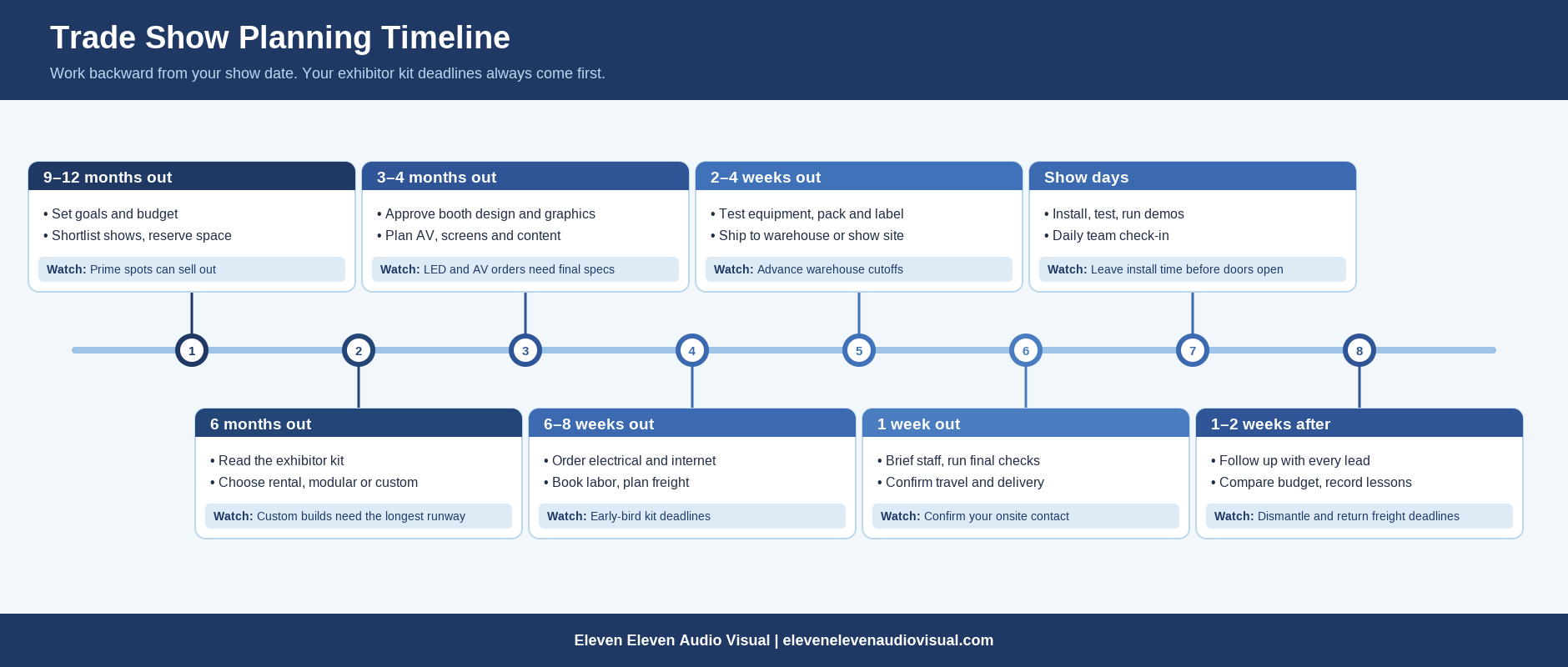
|
Stage |
Big national shows |
Regional and mid-size shows |
What to do |
Lead times to watch |
|
1. Plan and reserve |
9-12 months out |
3-6 months out |
Set goals, shortlist shows, set a budget, reserve booth space |
Big shows can sell out prime locations early; regional shows often open registration later |
|
2. Read the kit, pick a booth |
6 months out |
10-12 weeks out |
Read the exhibitor kit, confirm venue rules, choose rental, modular or custom, request quotes |
Custom builds need the longest runway |
|
3. Design and plan AV |
3-4 months out |
6-8 weeks out |
Approve booth design and graphics, plan AV, screens and content |
LED and larger AV orders need final specs; on a short runway, rental or modular fits best |
|
4. Order and arrange logistics |
6-8 weeks out |
4-6 weeks out |
Order electrical and internet, book labor, plan freight, start promoting |
Exhibitor kit discount deadlines often land here |
|
5. Test, pack and ship |
2-4 weeks out |
2-3 weeks out |
Test equipment and content, pack and label, ship to the advance warehouse or show site |
Advance warehouse cutoffs; late freight can add direct-to-site fees |
|
6. Final week |
1 week out |
1 week out |
Brief staff, run final checks, confirm travel and delivery |
Confirm your onsite contact and move-in time |
|
7. Show days |
Show days |
Show days |
Install, test, run demos, hold a daily team check-in |
Leave install time before doors open |
|
8. After the show |
1-2 weeks after |
1-2 weeks after |
Follow up with leads, compare budget to actual, record lessons |
Dismantle and return freight deadlines |
Tip: Before anything else, copy every deadline from the exhibitor kit into your calendar. It's about an hour of work and it prevents most of the expensive surprises.
Show is closer than you'd like?
If you're inside eight weeks, protect the parts that can't be rushed:
- Weeks 8-7: Lock your goals, read the kit, and pick a rental or simple modular booth. Rentals are usually the fastest route.
- Weeks 6-5: Approve layout and graphics, and send AV specs to your provider.
- Week 4: Place electrical and internet orders, and confirm labor and freight.
- Weeks 3-2: Test equipment and content, then ship.
- Week 1: Brief the team, confirm your onsite contact, and double-check travel.
A custom build that starts in week four rarely fits. Ask your provider what's realistic before you fall in love with a design.
How to Plan a Trade Show in 10 Steps
Planning a trade show goes best in a fixed order: goals first, then the show and its rules, the budget, the booth and AV, logistics, promotion, your team, show days and follow-up. Here's the details.
1. Decide What the Show Is Actually For
It sounds obvious, but "get our name out there" is not a goal. Two or three specific ones are enough, and they should shape everything that follows, from booth layout to how many people you send.
|
If your goal is... |
A measurable version |
What it changes about the booth |
|---|---|---|
|
Generate leads |
Qualified leads captured per day |
Fast lead capture, a clear call to action, open sightlines |
|
Show a product |
Demos completed, demo-to-meeting rate |
A demo station, a screen sized for small groups, room to stand |
|
Meet existing customers |
Meetings booked before the show |
Seating, quieter sound, a spot to talk without blocking the aisle |
|
Build awareness |
Booth visits, content engagement, press or social mentions |
Strong overhead visibility and a screen that draws people in |
Some teams measure return on investment. Others prefer return on objectives, which asks whether you hit the goals you set even if the revenue arrives months later. Pick one and write the targets down. Nothing here promises a particular result, since that depends on the show, the audience and your follow-up. The point is to know, afterward, whether it worked.
2. Choose the Show, Then Read the Exhibitor Kit Before You Pay
Compare shows on who actually attends, not just how many. A smaller event full of your buyers beats a huge one where you're one booth among thousands.
Once you've picked, download the exhibitor kit (some organizers call it the exhibitor manual or service kit). It's long and it's tedious, and it's where the rules live. Look for these first:
1
Move-in and move-out windows.
When can you load in, and for how long?
2
Ceiling height and rigging limits.
This decides whether a hanging sign or tall display is possible at all.
3
Power and internet.
What's included, what's extra, and when do discounted orders close?
4
Labor rules.
Some venues require union labor for certain tasks, such as unloading, rigging or electrical.
5
Booth display restrictions.
Height limits, sightline rules, and what you can place near neighbors.
6
Freight instructions.
Advance warehouse address and cutoff date, or direct-to-site delivery rules.
Then get the floor plan and look at where your booth sits. Columns, entrances and a loud neighbor can change your design more than any brand guideline.
Why it matters: A booth designed around a 20-foot hanging sign is a problem if the venue caps rigging at a lower height. It's far cheaper to find out in month six than in the hall.
3. Build a Trade Show Budget That Includes the Boring Costs
The booth space fee is the number everyone remembers. The costs around it are where budgets slip, so list them before you pick a booth.
|
Cost area |
What it covers |
Easy to miss |
|---|---|---|
|
Booth space |
Space fee from the organizer |
Premiums for corner or island spaces, late-booking surcharges |
|
Booth |
Rental, modular or custom build, graphics |
Graphic revisions, storage between shows, repairs |
|
AV and technology |
Screens, lighting, sound, players, content |
Spare equipment, content formatting, a technician |
|
Show services |
Electrical, internet, furniture, cleaning |
Missing the early-order discount |
|
Material handling (drayage) |
Moving freight between the dock and your booth, and back |
Often charged by weight, sometimes with minimums |
|
Labor |
Install, dismantle, electricians, riggers |
Venue labor rules and overtime windows |
|
Freight |
Shipping to the show and back |
Late-arrival fees and direct-to-site surcharges |
|
Travel and staff |
Flights, hotels, meals, staff time |
Extra people needed on setup days |
|
Marketing |
Pre-show outreach, giveaways, lead capture |
Renting a lead retrieval device |
|
Contingency |
A buffer for surprises |
Many exhibitors hold back around 10%; adjust to your risk |
Get written quotes, and ask what each one includes. Two quotes that look different often just cover different things. The planner's Budget tab has these categories built in, with estimated and actual columns.
4. Pick Your Booth Approach
There isn't one right answer. How often you exhibit usually decides it.
|
Option |
Best for |
Trade-offs |
|---|---|---|
|
Rental |
One or two shows a year, tight upfront budget |
Less customization, and you don't own it |
|
Modular (owned) |
Several shows in different booth sizes |
Reconfigurable, but limited by the system's design |
|
Custom build |
Regular exhibitors with specific demo or brand needs |
Longest lead time and the highest upfront cost |
Whichever you choose, design around how people will move. Where does the greeter stand? Where do demos run? Where can two people talk without clogging the aisle? A booth built for demos needs a big screen and standing room. A booth built for meetings needs seating and quieter sound.
For layout inspiration, our roundup of trade show booth design ideas shows what works at different sizes.
One practical advantage of working with a provider that fabricates in-house, as Eleven Eleven Audio Visual does, is that design changes don't wait on an outside shop. If a frame needs adjusting before it ships, it's fixed in the workshop and not discovered at move-in.
5. Plan the AV Before the Design Is Final
Screens, sound and lighting are usually treated as extras to add once the booth is designed. That's backward. Screen size, mounting, power and cabling shape the structure, so the two need to be planned together.
Things to settle early:
- Screen size and placement. Visitors farther away need bigger screens, and the booth footprint limits how big you can go. Ask your provider to size it against your floor plan.
- Content. Get file formats, aspect ratios and deadlines from your AV team, then build video to match. Content made for a laptop screen often looks wrong on a wall. If you need new video made for the booth, event video services can produce it to the right specs.
- Lighting. Convention halls are bright, and screens and graphics can look washed out. Plan event lighting solutions together with the booth design so your products and displays read well.
- Sound. Halls are loud and neighbors are close. Decide early whether you need event sound system rental, and keep audio aimed at your own booth so it doesn't fight the next one.
- Power and internet. Order them through the exhibitor kit, and before the discount deadline.
- Backups. Spare cables, a spare media player, a laptop with the content loaded.
- Testing. Everything should be assembled and tested before it ships, not for the first time on the floor.
More on how screens and structures fit together is in our guide to trade show display and AV integration.
Seven questions to ask any AV provider
- Who designs, installs and stays onsite during the show?
- What's included in the price: delivery, install, a technician, dismantle?
- What are your lead times for LED and custom AV orders?
- How do you size screens for our booth and viewing distance?
- What backup equipment do you bring, and what happens if something fails?
- How do you handle venue rules for rigging, power and labor?
- Can you quote the booth and the AV together?
If you'd rather have one team handle the structure, the screens and the setup, that's the model behind our trade show production services.
Not sure a screen will fit your floor plan? Send us your booth dimensions and the show name, and we'll tell you what screen size and layout work before you order anything.
6. Sort Out Freight, Labor and Paperwork
This is the part nobody enjoys and everybody notices when it goes wrong.
Picture this: your booth ships a week late, the advance warehouse has closed, and the only option is direct-to-site delivery at a time slot you didn't book. Nothing is broken. You just spent a lot of money and a lot of mornings waiting at a dock.
The usual choice is between two delivery methods.
|
Method |
How it works |
Watch for |
|---|---|---|
|
Advance warehouse |
Freight arrives before the show and is held, then delivered to your booth by the show's contractor |
A firm cutoff date, storage and handling charges |
|
Direct to site |
Freight is delivered to the venue on or near move-in day |
Dock appointments, waiting time, possible surcharges |
Who does what matters too, because it's easy to assume someone else has it covered.
|
Who |
Typically responsible for |
|---|---|
|
You (the exhibitor) |
Goals, budget, content, staffing, ordering show services |
|
Your booth and AV partner |
Design, build or rental, equipment, install and testing |
|
The show contractor |
Material handling, labor, furniture, electrical and internet orders |
|
The venue |
Building rules, dock access, rigging approvals, insurance requirements |
Also complete the paperwork early. Venues often want certificates of insurance and labor forms before they let a crew in. Then write a short contingency plan: who you call if freight is late, what you do if a screen fails, and who has authority to approve a fix.
7. Promote Before You Arrive
A booth gets its best traffic from people who already planned to visit it. You don't need a huge campaign, just a few things done early:
- Announce your attendance on email, LinkedIn and your website, with your booth number.
- Invite customers and prospects directly, and book meetings before the show.
- Give people a reason to stop: a demo time, a product reveal, a scheduled talk.
- Prepare handouts or a QR code that leads somewhere useful, not just to your homepage.
This guide only covers promotion as it relates to planning. For the full approach to attracting and converting visitors, see our trade show marketing strategy article.
8. Get Your Team Ready
The best booth still fails with staff who don't know why they're there. A week before the show:
- Assign roles. Who greets, who demos, who captures leads, who handles meetings, who takes breaks and when.
- Brief everyone on the message. One sentence on what you do, and the three things you want visitors to remember.
- Rehearse the demo. Run it with the real equipment, and time it.
- Set up lead capture and test it. Decide what to record (interest level, next step) so follow-up is easy later.
- Plan breaks. Booth fatigue is real, and long days go badly with a skeleton crew.
9. Run the Show Days
- Walk to the booth before the doors open. Check screens, lighting, sound, power, graphics and furniture.
- Know your onsite contact. One person who can approve a fix, call the AV team or talk to the show contractor.
- Hold a short huddle each morning. Review the day's targets, demos and meetings.
- Log leads each evening. Notes written the same day are far better than notes written next week.
- Keep an eye on the tech. Check screens and content between visitors, not after something goes wrong.
- Supervise dismantle. Make sure everything is packed, labeled and shipped to the right place.
10. Follow Up and Review
The week after the show decides much of the payoff. Contact every lead within a week, while the conversation is fresh, and tell them something specific from your chat. If you tagged leads by interest level at the booth, start with the hottest. A short clip from a demo or talk makes a follow-up email easier to remember, and an event recording service can capture sessions for that. Prospects who couldn't make the show can join a follow-up webinar, which a virtual event production team can run for you.
Then review the show against the goals you set in step one.
|
Question |
Where to find the answer |
|---|---|
|
Did we hit our lead and meeting targets? |
Lead capture data, meeting log |
|
Did the booth support our goals? |
Team feedback, photos, notes on traffic flow |
|
Did we stay within budget? |
Budget tab, estimated vs actual |
|
What went wrong with logistics or tech? |
Daily notes, vendor feedback |
|
What should we change next time? |
Everything above |
Write the lessons down while they're fresh. Next year's plan will start from them.
Organizing Your Own Trade Show?
The steps change when you're the host. You'll need to pick a venue, set a floor plan, create an exhibitor prospectus with booth sizes and pricing, and sell space early. You'll also write the exhibitor kit, set labor and freight rules with the venue, and market the show to attendees. Plan more time than you think you need, since exhibitors can't commit until you've published dates, pricing and rules. If your show also reaches remote attendees, a hybrid event production team can plan the streaming and the in-room AV together. And if you're coordinating AV, staging or exhibitor services as part of the event, bring your production partner in during venue selection, not after
Trade Show Checklist by Stage
|
Stage |
Checklist item |
|---|---|
|
Goals |
Write 2-3 specific goals and how you'll measure them |
|
Show and venue |
Reserve space, read the exhibitor kit, note every deadline |
|
Budget |
List all costs, including drayage, labor, power and freight, and add a buffer |
|
Booth |
Choose rental, modular or custom, and approve layout and graphics |
|
AV |
Size screens, prepare content, order power and internet, plan backups |
|
Logistics |
Choose advance warehouse or direct-to-site, book labor, file paperwork |
|
Promotion and team |
Announce attendance, book meetings, assign roles, brief staff |
|
Show days |
Walk the booth, confirm your onsite contact, log leads daily |
|
After |
Follow up within a week, review against goals, record lessons |
The Excel planner turns this into a working checklist with 49 tasks, due dates, a budget tracker and an AV provider comparison sheet.
Mistakes That Cost Exhibitors the Most
- Treating AV as an afterthought. Screens and cabling affect the booth structure, so plan them together.
- Not reading the exhibitor kit. Rigging limits, labor rules and early-order deadlines are all in there.
- Budgeting only for the booth. Drayage, labor, electrical and freight add up quickly.
- Starting a custom build too late. If the lead time doesn't fit, rent or go modular.
- No onsite point of contact. When something fails at 8 a.m., someone has to decide quickly.
- No backup plan. One spare player or cable can save a show day.
- Skipping the follow-up. A good show with no follow-up is a missed opportunity.
Frequently Asked Questions About Planning a Trade Show
Ready to Lock In Your Booth and AV?
Let Eleven Eleven Audio Visual handle your booth, AV, and freight deadlines for a seamless trade show experience.